The game
Your body is your build. The tower makes an offer. You live with the price.
The Depths is a solo and cooperative action roguelike about descending a demon’s tower, binding powers to your body, and accepting increasingly tempting replacements. The tower wears you down. Its gifts help you survive while changing what you are.
The central fantasy is accepting deals until you have made yourself into a monster, with the desperation of being dismantled to survive. The descent creates need; bargains offer a dangerous response. Sacrifice is an optional temptation, and every accepted bargain carries a consequence for the expedition.
The dungeon remembers through recognizable objects: your runes, surrendered limbs, and the ruler left behind after victory. A familiar mark on an unfamiliar body should tell a story without an explanation screen.
Format: single player and co-op multiplayer. PC, up to four players, real-time third-person combat, procedural floors, and 30–45-minute runs are working targets.
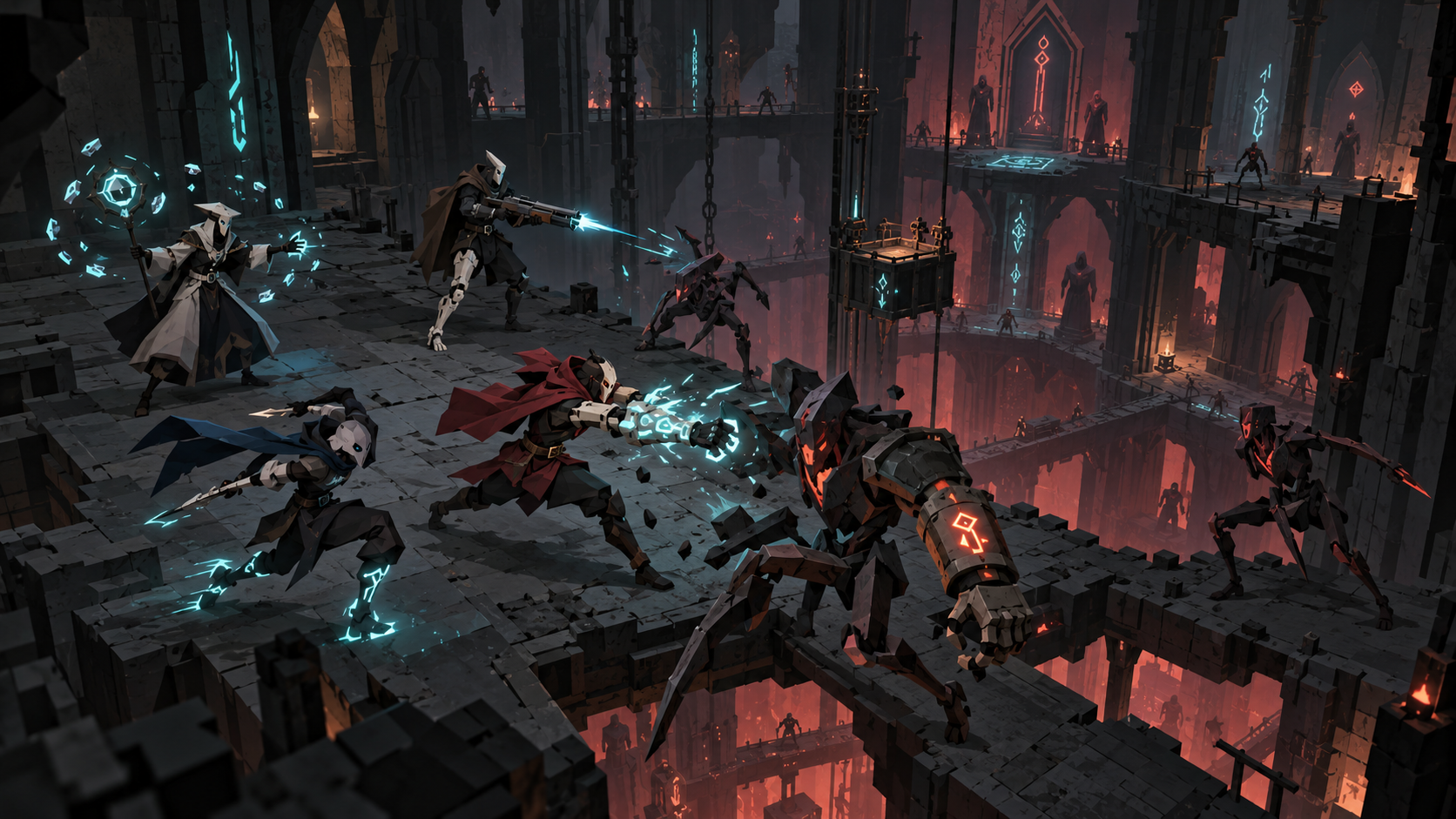
How much of yourself
would you trade to survive?
One descent, many compromises
Explore a floor → fight and discover runes → imbue your body → encounter an offer → accept or refuse → adapt and descend → confront the Demon Lord.
Fight and build. Powers live on appendages. A limb carries both its mechanical investment and a visual identity. Different builds should change how players approach encounters and cooperate.
Consider the offer. The advertised benefit is understandable; the exact cost can be concealed. The tower’s offers become more attractive as the descent becomes more demanding. Whether offers improve through authored depth tiers or react to a player’s situation is still open.
Commit and adapt. Accepting a bargain changes the build and incurs a consequence that lasts for this expedition. A further replacement does not erase that debt. Refusing should remain a viable route to test, rather than a disguised failure state.
Face what remains. Some surrendered powers become recognizable enemy or boss abilities. Victory makes the adventurer—or the victorious party—the next Demon Lord. The detailed inheritance rules are still proposals.
- Fight
- Imbue
- Consider
- Adapt
- Descend
The body is the build
Runes bind to body parts. Arms can shape attacks; legs can change movement, strength, or stability. The body’s slot structure needs to balance expressive builds with readable combat. Fingers and toes are possible rune locations; their useful level of detail is an open design question.
Surrendering a limb removes its rune investment. Its replacement has a new silhouette and capabilities, and can receive runes. Basic movement and attacks must remain usable.
Prosthetics have inherent trade-offs: an anchor leg offers stability at the cost of speed, while a piston arm favors heavier, slower hits. These are illustrative designs, not a fixed item list. A bargain can add a hidden consequence beyond an advertised capability.
Reclamation: enemies can carry surrendered limbs. Recovering an old arm creates a choice between familiar runes and a replacement you have grown to depend on. Recovery must not undo the lasting cost of a bargain. Drop rules, storage, reattachment, and removal of a boss contribution remain unresolved.
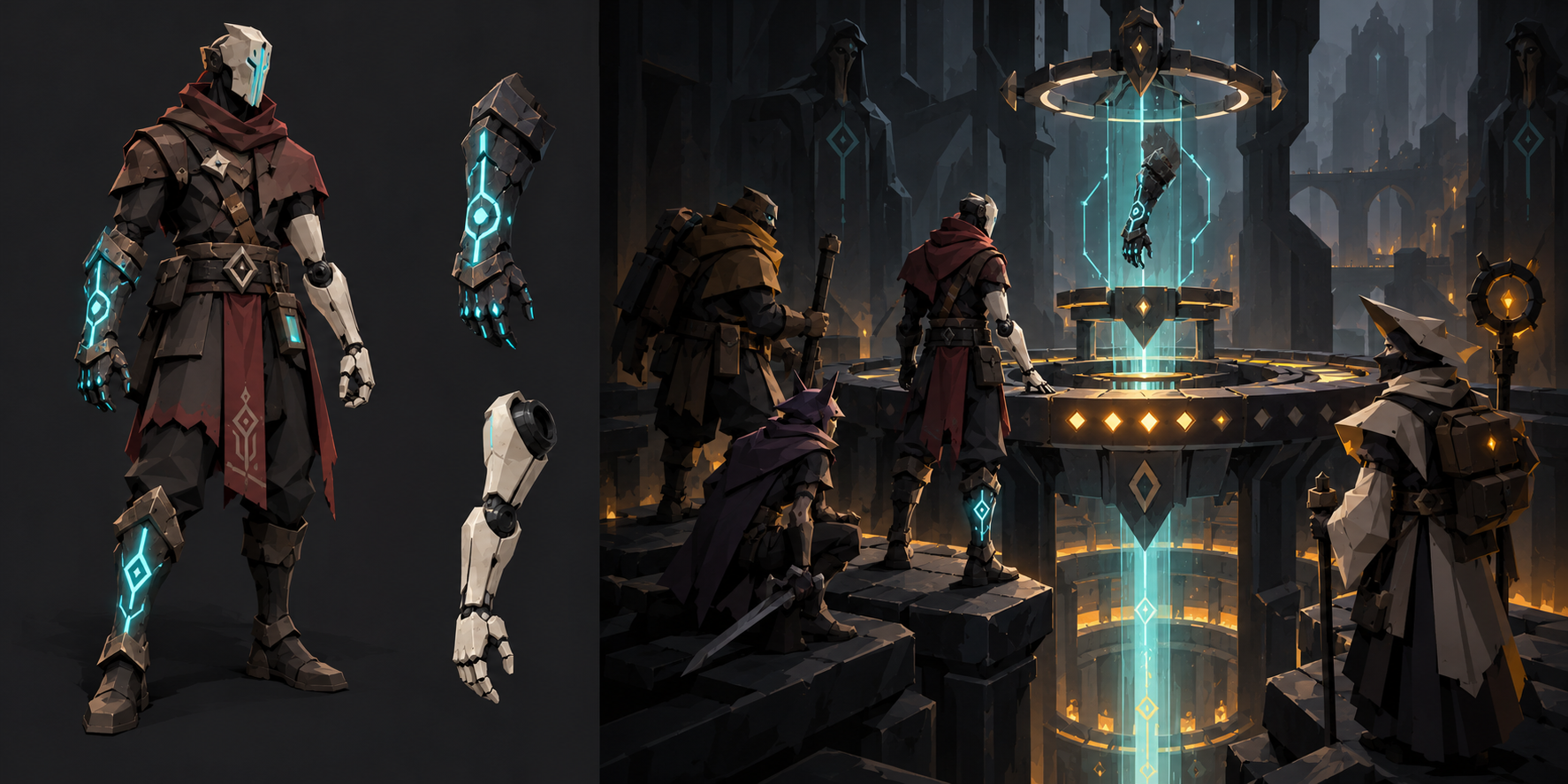
A mark that belongs to you
An emblem-style creator uses authored pieces and constraints to give runes a personal identity. Players customize appearance; the game supplies mechanical rune effects.
Every player starts with an automatically generated design. Customization happens before a run and is optional. Finding or equipping a rune never requires stopping to draw, name, or design it. A player who wants to jump straight in gets the full game.
A personal seal establishes ownership. A consistent effect marking communicates the power. When a player acquires a rune, the game combines the two automatically. A constrained vocabulary of central symbols, surrounding strokes, rotation, mirroring, and finishes keeps the results personal and native to the world.
Players can become attached through creating the mark, using the power, or both. The design needs to support someone who spends time making a distinctive seal and someone who accepts the generated default.
Preserve the exact original glyph whenever ownership changes. Surrounding flesh and machinery can become corrupted, but the composition remains intact. The mark must still be recognizable on the Demon Lord. Consistent effect markings also help teammates anticipate an unfamiliar player’s transferred ability.
Use the rune sketchbook below to explore that balance of expression and recognition. Its shapes and controls are examples, not a specification for the final game editor.
Rune sketchbook
Visual exploration · lightning effectWith a standard lightning mark
A power you learn to recognize
The exact same mark survives
A generated seal is ready to use.
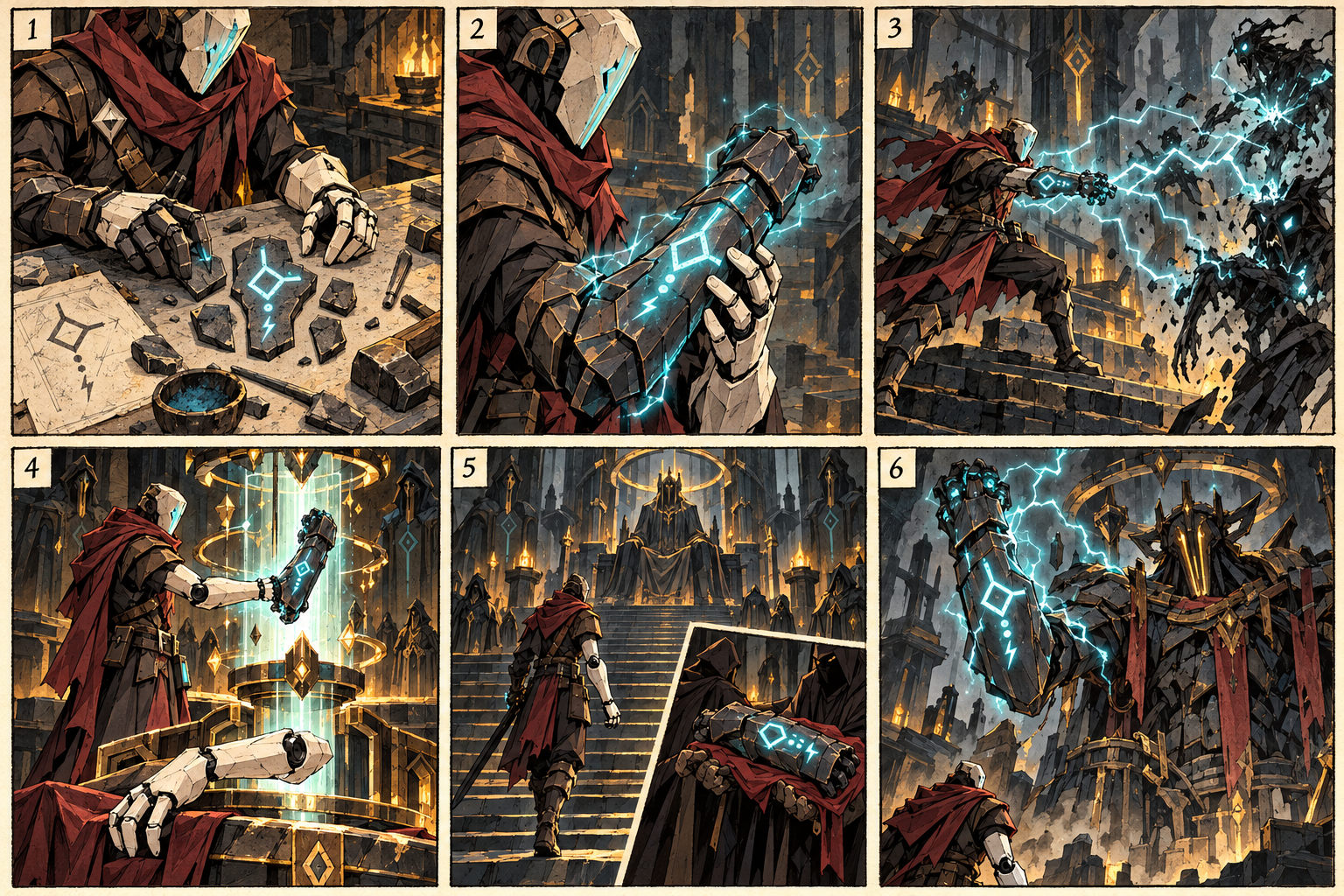
“That was my arm.”
This sequence captures the emotional payoff we want to test. The same personally recognizable rune survives every transfer.
- Before the expedition: design a seal, or accept a generated one.
- Discovery: find a lightning rune; your seal and the standard effect marking appear on your forearm.
- Attachment: use that arm to chain lightning through enemies over several floors.
- Temptation: surrender the arm for an attractive replacement.
- Absence: continue with a different body while the surrendered limb travels below.
- Recognition: the Demon Lord raises an arm bearing your exact mark. It begins to pulse. You know what comes next.
Not every bargain needs to end in this scene. It illustrates the branch where an offering becomes part of the boss. The comic is preproduction concept art, not a promise about final character models or the game’s camera.
The next ruler remembers
Defeating the Demon Lord makes the victor its successor. In co-op, the narrative direction forms one composite ruler from the winning party. Their exact marks and recognizable abilities can become the next boss’s identity.
Lineage selection — design proposal. At lobby creation, choose between continuing the host’s saved lineage and beginning a fresh one. Solo expeditions use the same choice.
A continued lineage supplies the ruler’s base identity. Current-run offerings can then alter that ruler. A fresh lineage begins with a starting Demon Lord. Saving a new branch separately would preserve an existing history.
A possible co-op rule selects a few defining traits from each victor to create one composite successor. Trait selection, the inheritance budget, and save ownership are open design decisions.
Inheritance should preserve identity. A ruler’s recognizable abilities and personal rune marks matter more than accumulating every predecessor’s strength. The difficulty model needs to keep repeat expeditions approachable while making each successor distinctive.
Rebirth — narrative proposal. The tower reconstructs new incarnations from surrendered humanity. This explains repeated expeditions without requiring curses or character statistics to persist.
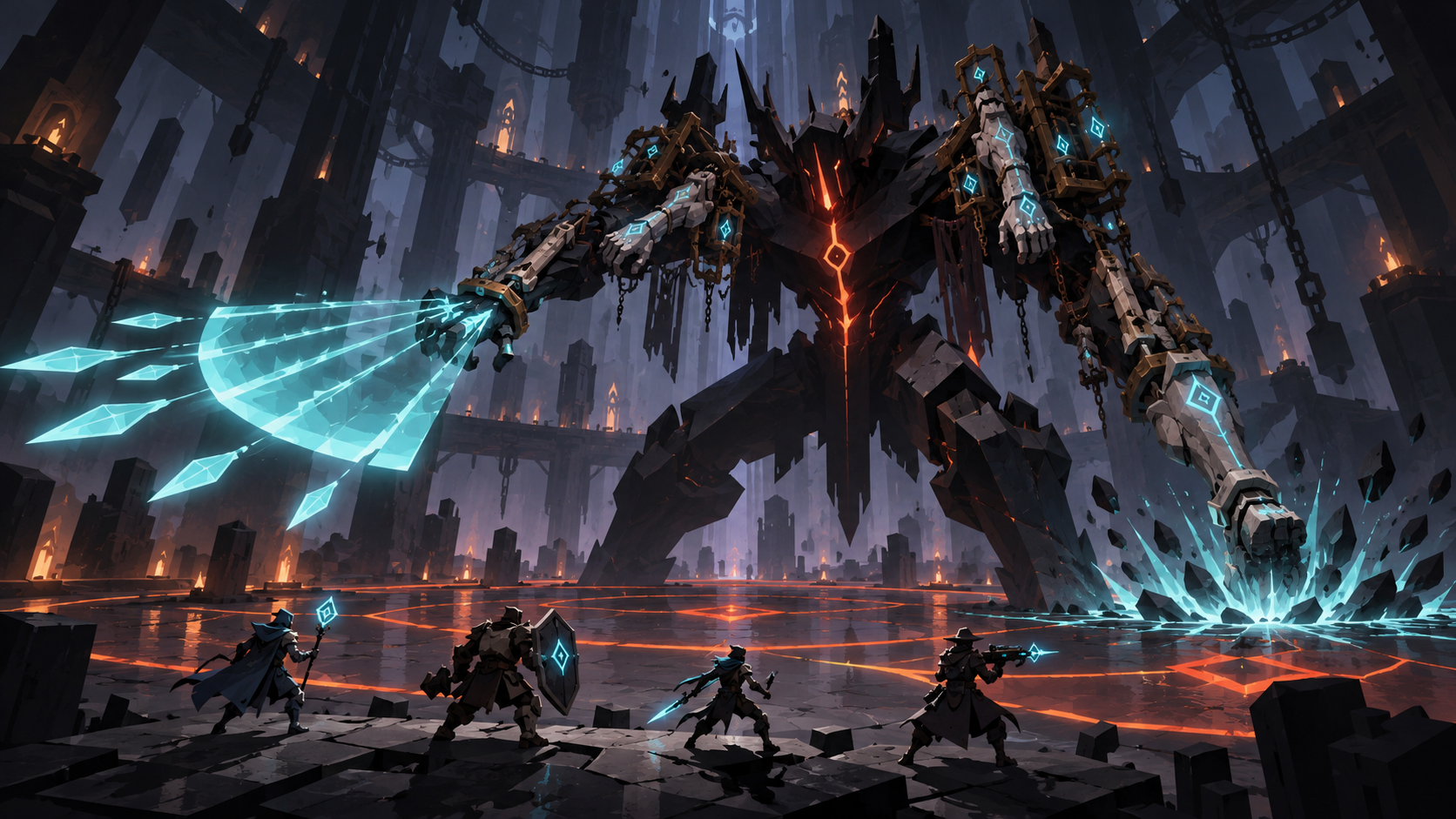
A tower that keeps its gifts
Faceted low-poly forms, gothic shadows, ancient science-fiction machinery, luminous body runes, and ceramic-and-metal replacements establish the world’s visual language. Masks, cloth, flesh, and machinery make a changing body readable.
Floors are discrete stages of the expedition, connected through descending rooms, shaft-side walkways, and ritual spaces. Combat pressure and discovery give offers their context. The tower should feel like it is preparing a successor.
Rune light communicates ownership and impending attacks. A familiar mark charging on a hostile arm is both a story beat and a combat cue. A familiar ability sound can reinforce that recognition; low drones, metal echoes, and ritual machinery support the descent. The audio treatment is a design proposal.
Enemies carrying surrendered limbs give the dungeon a visible memory. A recognizable rune or mismatched appendage can suggest another adventurer’s history before its power is revealed in combat.
Questions still worth asking
- Hidden costs: are they fixed discoveries, themed variations, or true gambles? When does the player learn the exact consequence?
- Refusal: can the ordinary build remain satisfying and viable without bargains? What makes a late offer genuinely tempting?
- Co-op consent: if one player gains power but the whole party inherits danger, who accepts the offer? Solo must work without negotiation.
- Bodies: how many useful slots can combat and the HUD support? Do fingers and toes add decisions worth their complexity?
- Reclamation: what happens if a surrendered limb is recovered before the boss? The bargain’s debt still persists.
- Inheritance: which player traits become attacks, defenses, visuals, or rune marks? What is the cap, and what does starting fresh preserve?
- Rune recognition: how much visual freedom can we allow while keeping ownership and effects readable at combat distance?
- Offer delivery: ritual gates are established imagery. Are bargains always at safe transitions, or encountered elsewhere?
The smallest useful test
First playable — proposed scope: one shared combat slice supporting solo and two-player co-op; three floors; a small authored rune set; three optional bargain types; and one Demon Lord capable of visibly using one surrendered power. These are test limits, not final production scope.
Provide generated rune seals from the start and a modest pre-run editor. At least one bargain should create a player-side drawback and another should transfer an identifiable limb or power to the boss. Keep every accepted debt for the rest of the test run.
Watch whether players hesitate, accept, adapt, and later recognize what they gave away. Ask whether a hidden consequence feels connected to the gift, whether declining remains enjoyable, and whether the boss’s inherited move is readable.
Test the same rune sequence with players who customize and players who immediately accept the default. Both should be able to recognize ownership through use.
Use one authored successor encounter to test the feeling of inheritance before building a complete persistent lineage system.